

Shaft assembly machining efficiency improved by 16.15%! Unveiling how SIGER's Efficiency Optimization System "saves" 309 seconds for vertical machining centers!
Company News Date:2026/08/31

In a precision bushing parts machining workshop, a FANUC vertical machining center is handling the batch precision machining of large quantities of metal bushings. These parts involve multiple processes, including end milling, internal boring, and contour machining. The process involves frequent changes in process direction and drastic load fluctuations, demanding extremely high dimensional accuracy and surface quality consistency across all processes. For a long time, the operating team has been struggling to balance speed and stability:
◆ Speeding up? Milling is intermittent cutting, with the spindle load fluctuating wildly; boring is continuous cutting, allowing no room for fluctuation. Sudden changes in cutting conditions during process changes can easily trigger vibrations, resulting in surface chatter marks or machining ripples, and even affecting the dimensional accuracy of the internal holes.
◆ Slowing down? To balance boring accuracy and milling stability, the overall feed parameters are forced to be conservative, severely suppressing efficiency in end face and low-load areas, resulting in high single-piece times and hindering production capacity. In the traditional model, multiple alternating processes rely on manual programming, making it impossible to match the load characteristics of each process stage in real time. The parameters "compromised" by experienced operators suffer significant stability degradation once tool changes or batches are replaced.
With the deep integration of the SIGER Data Adaptive Machining System (AMS), this barrier between "efficiency and quality" has been completely broken down—enabling the machining of bushing-type parts with "process awareness" ,translating real-time load changes into improvements in both cycle time and quality.
1. Addressing Key Pain Points: Three Major Challenges in Multi-Process Machining of Bushings
For bushings that switch between end milling, internal boring, and contour machining, the shortcomings of traditional fixed feed strategies are glaringly apparent:
❌ Sudden Load Changes During Process Switching, Making Stability Uncertain
Milling is intermittent cutting with large load fluctuations; boring is continuous cutting, requiring near-perfect stability. When these two processes alternate, load mismatches repeatedly occur, constantly jeopardizing the stability of the entire cutting process.
❌ Overlapping Rigidity Differences in Clamping Structures Lead to Localized Deterioration
While rear-mounted clamping maintains positioning accuracy, the inherent differences in support stiffness across different parts of the workpiece cause inconsistent cutting performance in different areas, further exacerbating machining fluctuations.
❌ The machine tool's potential was locked down by catering to the most difficult working conditions throughout the entire process
To simultaneously meet the requirements of boring accuracy and milling smoothness, the feed rate of the entire program must be reduced overall. The efficiency margin in the end face and light-load sections is largely sealed off, effectively locking in the machine's potential performance.
2. Intelligent Solution: SIGER Adaptive Machining System Enables Machine Tools to "Calculate While Cutting"
The SIGER Data Adaptive Machining System (AMS) establishes a complete closed loop of "real-time perception → AI decision-making → smooth execution", rejecting simplistic and crude overall acceleration and deceleration:
✅ Intelligent Speed Adjustment Based on Process Characteristics, Unleashing Low-Load Potential
The system collects spindle power load signals in real time through high-precision sensors and automatically identifies different process stages such as face milling and internal boring. It automatically increases the feed rate in low-load areas to improve material removal efficiency; when the load approaches a threshold, it dynamically reduces the feed rate to ensure stable cutting and achieve a precise balance between efficiency and safety.
✅ Smooth Transition Between Processes, Suppressing Vibration and Ensuring Quality
In the alternating and transitional areas between face milling and internal boring, the system dynamically matches different states of intermittent and continuous cutting. By suppressing overshoot and filtering noise, it achieves continuous and smooth adjustment of feed changes, completely eliminating vibration marks and machining ripples, ensuring consistent internal hole dimensional accuracy and surface quality.
✅ One program, adaptable to multiple cutting states
Without modifying the original machining program, the system automatically learns the workpiece characteristics and process switching nodes, realizing an optimized mode of "one program, multiple processes adapted", enabling the machine tool to truly have process self-adaptability.
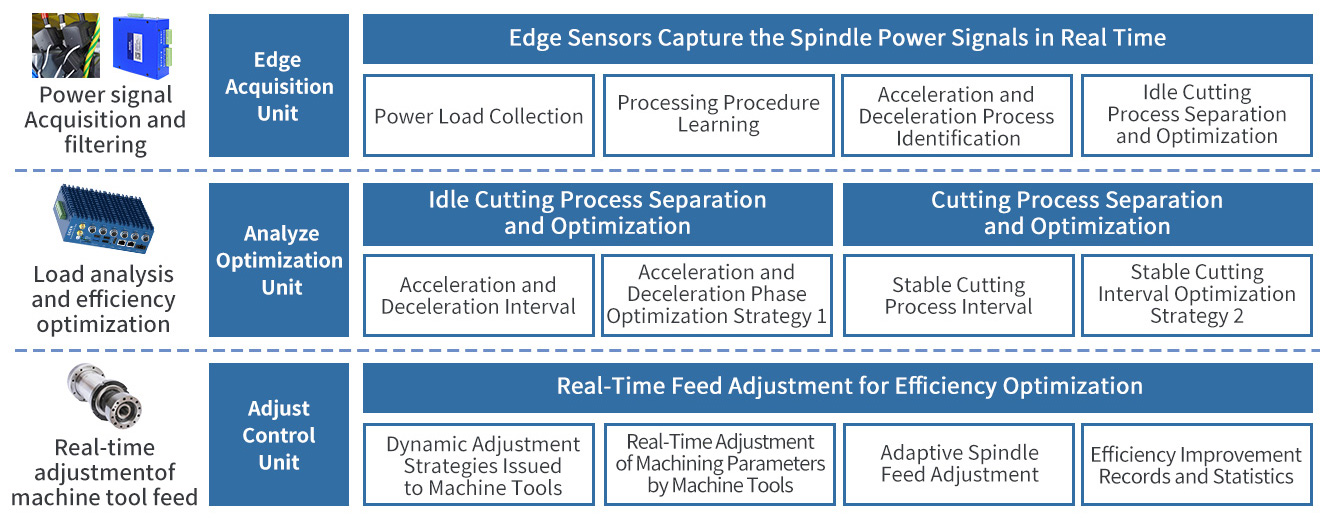
(Optimization principle and implementation diagram)
3. Practical Value: 16.15% Efficiency Improvement, 309-second Saving per Part
In the actual scenario of mass production of bushing-type parts using this FANUC vertical machining center, the SIGER Adaptive Machining System (AMS) delivered impressive results:
■ Before Modification: Single-part machining cycle time: 1913 seconds
■ After Modification: Single-part machining cycle time: 1604 seconds
■ Overall Machining Efficiency Improvement: 16.15% (reduced by 309 seconds)
More importantly, this improvement did not come at the expense of quality—in key processes such as end milling, internal boring, and process switching, the SIGER AMS system ensured extreme stability in the cutting process by smoothly adjusting the feed, eliminating chatter marks and machining ripples. Both dimensional accuracy and surface quality met standards, making "fast but not rough" a reality.
4. Beyond Data: Panoramic Value for Customers
The value of SIGER Data's Adaptive Machining System (AMS) extends far beyond simply reducing cycle time per piece. It builds a core competitive advantage for enterprises, enabling sustainable evolution:
4.1 Unleashing Hidden Capacity
A 16.15% efficiency improvement translates to releasing over one-sixth of production capacity without adding equipment. With the same equipment and personnel, dozens more high-precision bushings can be produced daily.
4.2 24/7 Quality Assurance
Intelligent and smooth feed adjustment effectively suppresses sudden load changes caused by process switching. Eliminates vibration marks and machining ripples, improving yield and reducing rework costs.
4.3 Digital Intelligence Accumulation
Transforming experienced speed adjustment techniques based on intuition into quantifiable, learnable, and reusable optimal parameter models. Significantly shortening the adoption cycle for new processes, new workpieces, and new employees.
4.4 Reusing underlying hardware to expand digital production lines
The system boasts strong foresight and scalability. Based on a pre-deployed set of underlying hardware, enterprises can seamlessly expand tool monitoring (TMS), machine spindle collision protection (TCS), machine spindle dynamic balance monitoring (DBS), thermal compensation management system (CMS), and equipment health management system (PHM) as needed in the future. This achieves a "six-in-one" solution with extremely low additional costs, steadily building a truly digital production line.
5. Rapid Deployment, Zero-Risk Validation: Try it first, pay only if effective
SIGER Data Adaptive Machining System (AMS) helps manufacturers quickly improve efficiency with simple and hassle-free deployment:
Deployment and training can be completed in 3 days, and operation can be mastered in 1 hour.
No downtime or modification required, no changes to existing programs.
Compatible with over 98% of CNC systems, including FANUC, Siemens, and Tsugami.
Based on a single deployed underlying hardware, enterprises can seamlessly expand on future needs with Tool Monitoring System (TMS), Spindle Collision Protection System (TCS), Machine Tool Spindle Dynamic Balance Monitoring System (DBS), Thermal Compensation Management System (CMS), and Equipment Health Management System (PHM), achieving a "six-in-one" solution at extremely low additional cost, helping enterprises build digital production lines.
We've also introduced a zero-risk verification model to completely dispel your concerns: try it first, pay only if it works. Our engineers will bring your equipment to your location for three days of on-site testing, letting real data speak for itself; you only pay after your machine tool's efficiency improves, and if there's no effect, you don't pay a cent. We help you break through conservative parameter limitations and unleash your machine tool's potential without worry. Welcome to call for inquiries!
If you are interested in SIGER products, you can contact us by phone or email, or submit your requirements by leaving a message, and we will arrange personnel to contact you as soon as possible.
--------------------------------------------------------------------------------------------------------------------------------------------------------
Official Contact Info:
Email: marketing@siger-data.com
WhatsApp: +86 189 6235 3927
WeChat: 189 6235 3927