


Fixture-based block machining efficiency improved by 16.84%! Unveiling SIGER's Efficiency Optimization Solution, empowering vertical machining centers to achieve "autonomous driving"
Company News Date:2026/07/20

In a precision manufacturing workshop, a vertical machining center is undertaking the precision machining task of a large batch of fixture positioning blocks. This part involves multiple precision machining processes including milling, drilling, and tapping, requiring extremely high hole position accuracy and process switching stability. The operators have long been grappling with a "battle between efficiency and quality":
◆ Speeding up? The milling stage involves consistently high surface contact loads, drilling experiences significant abrupt axial load changes, and tapping involves frequent forward and reverse rotations with drastic load fluctuations. If the feed rate is too fast, vibration immediately becomes apparent, leaving only chatter marks or even causing excessive hole dimensional deviations.
◆ Slowing down? Large milling areas possess the potential for high-speed cutting, but this is wasted due to consistently low feed rates, resulting in lengthy cycle times and severely limiting the machine's inherent high performance.
With the introduction of the SIGER Data Adaptive Machining System (AMS), this impasse has been completely broken—granting the vertical machining center the ability to "real-time sense and autonomously decide," transforming instantaneous load feedback into tangible cycle time gains.
1. Addressing the Pain Points: The "Triple Shackles" of Multi-Process Machining of Fixture Blocks
For parts like fixture blocks, which involve alternating milling, drilling, and tapping processes, the limitations of traditional constant feed strategies are particularly pronounced:
❌ Large variations in cutting load across multiple processes, resulting in insufficient stability
From the high-surface contact load of milling to the abrupt axial impact of drilling, and the frequent fluctuations of tapping, the load changes rapidly throughout the entire machining process, making it difficult for a single control strategy to maintain stability throughout.
❌ Varied spatial angles lead to a severe disconnect between feed and cutting conditions
Under different machining orientations, the direction and magnitude of the force on the tool vary significantly. A constant feed rate cannot match the actual load requirements of each process, especially in high-precision areas. Once cutting stability is compromised, dimensional tolerances become difficult to guarantee.
❌ Fixed program parameters, unable to adapt to multiple working conditions
The optimal feed rates for each milling, drilling, and tapping process... The optimal parameters vary significantly, but traditional programs, once set, remain fixed and cannot be adjusted in real time according to uneven material allowances or tool conditions. To ensure thread quality, tapping processes often employ extremely conservative feed rates, making it difficult to balance thread accuracy and hole position tolerances, severely hindering efficiency.
❌ Conservative Process Experience, Machine Tool Potential Remains Dormant
To avoid tool overload or chipping, operators often artificially reduce the overall feed rate. This conservative "one-size-fits-all" strategy completely buries the high-speed cutting capability in light-load areas, significantly reducing the return on investment for equipment.
2. Intelligent Breakthrough: SIGER Adaptive Machining System (AMS) Empowers Machine Tools with "Dynamic Thinking" Capabilities
The SIGER Data Adaptive Machining System (AMS) establishes a fully closed-loop control chain of "real-time perception → AI decision-making → smooth execution," moving away from crude global acceleration and deceleration logic:
✅ Intelligent Speed Adjustment for Continuous Cutting, Unleashing Low-Load Potential
The system collects spindle power load signals in real time through high-precision sensors. In the light-load area of milling and the idle feed stage of drilling, it automatically and significantly increases the feed rate, releasing machine tool efficiency; when the load approaches the threshold, it dynamically reduces the feed rate to ensure cutting stability, achieving a perfect balance between efficiency and safety.
✅ High-Load Speed Reduction to Prevent Overload, Smooth Suppression of Load Sudden Changes
When the load approaches the safety threshold, the system actively reduces the speed in milliseconds; simultaneously, it identifies load sudden change trends in real time and smoothly adjusts the feed curve to effectively avoid the generation of vibration marks, ensuring product surface quality and hole accuracy.
✅ One program, adaptive to multiple structures and processes
Without modifying the original machining program, the system automatically learns the workpiece characteristics and achieves dynamic feed optimization under the alternation of multiple processes such as milling, drilling, and tapping, truly enabling the machine tool to "autopilot".
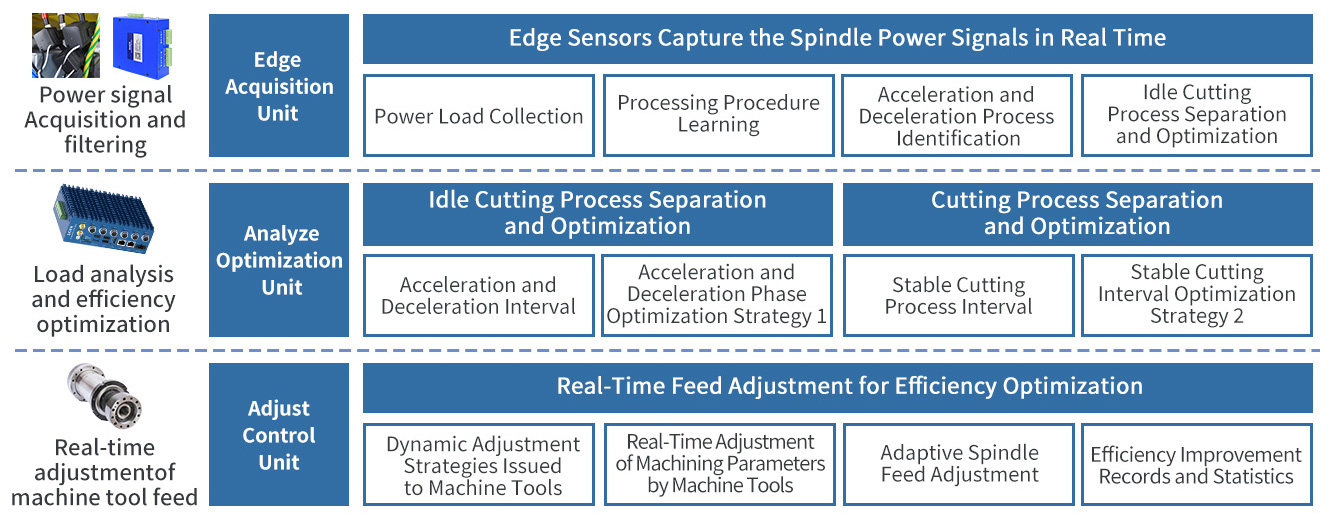
(Optimization principle and implementation diagram)
3. Real-world testing: 16.84% efficiency improvement, comprehensive speed-up across all stages
In the batch production verification of fixture blocks on this vertical machining center, SIGER's AMS adaptive machining system delivered outstanding results:
Original Single-Piece Machining Cycle Time: 2001seconds
Optimized Single-Piece Machining Cycle Time: 1664 seconds
Overall Machining Efficiency Improvement: 16.84% (reduced by 337 seconds)
More importantly, this leap in efficiency was achieved without any compromise in quality. At sensitive points such as drilling entry and exit, tapping forward and reverse rotation switching, and sudden changes in milling load, the SIGER Efficiency Optimization System (AMS), with its smooth and imperceptible feed adjustment, ensured extreme stability throughout the entire process of multiple alternating operations. Vibration marks were completely eliminated, and both hole position accuracy and thread quality passed rigorous testing, truly fulfilling the promise of "speeding up without sacrificing quality."
4. Beyond Data: Holistic Value for Customers
The value of the SIGER Data Adaptive Machining System (AMS) extends far beyond simply reducing cycle time per piece. It builds a core competitive advantage for enterprises, enabling sustainable evolution:
4.1 Unleashing Hidden Capacity: A 16.84% efficiency improvement means releasing more than one-fifth of capacity without adding equipment. With the same vertical machining center and the same workforce, single-shift output sees significant growth.
4.2 24/7 Quality Assurance: Intelligent feed smoothing effectively filters out vibration interference caused by sudden load changes during multi-process transitions. Eliminating vibration marks means a significant increase in yield and a substantial reduction in rework costs.
4.3 Digital Intelligence Accumulation: Transforming experienced speed adjustment techniques based on intuition into quantifiable, learnable, and reusable optimal parameter models. The introduction cycle for new processes, new workpieces, and new employees is significantly shortened.
4.4 Building a Digital Foundation: Continuously accumulated load-feed data streams build valuable core data assets for deeper process optimization, predictive maintenance, and even digital twins.
5. Rapid Deployment, Zero-Risk Validation: Try it first, pay only if effective
SIGER Adaptive Machining System (AMS) helps manufacturing industries quickly improve efficiency with simple and burden-free deployment:
Deployment and training can be completed in 3 days, and operation can be mastered in 1 hour.
No downtime or modification required, no changes to existing programs.
Compatible with over 98% of CNC systems, including FANUC, Siemens, and Tsugami.
Based on a single hardware system, it can also be seamlessly expanded on demand to provide a six-in-one solution encompassing Tool Monitoring System (TMS), Collision Protection System (TCS), Thermal Compensation Management System (CMS), Chip Detection System (CID), and Health Management System (PHM), helping enterprises build digital production lines.
SIGER's Adaptive Machining System (AMS) has been proven in real-world applications across multiple industries, including aerospace, precision mold making, and automotive parts. It's ready for immediate deployment, truly empowering the technology team and simplifying the workshop.
We also offer a zero-risk verification model to completely eliminate your concerns: try it first, pay only if effective. Our engineers will bring the equipment to your location for three days of on-site testing, letting real data speak for itself. Pay only after your machine tool efficiency improves; if there are no results, you don't pay a cent. This helps you break free from conservative parameter limitations and unleash your machine tool's potential. Welcome to contact us for inquiries!
If you are interested in SIGER products, you can contact us by phone or email, or submit your requirements by leaving a message, and we will arrange personnel to contact you as soon as possible.
--------------------------------------------------------------------------------------------------------------------------------------------------------
Official Contact Info:
Email: marketing@siger-data.com
WhatsApp: +86 189 6235 3927
WeChat: 189 6235 3927