提效 21.1%!刹车鼓法兰加工实战:解密西格数据AMS自适应加工系统如何改写立式加工中心效率
公司动态 日期:2026/05/11

在某汽车零部件加工车间,一台高刚性立式加工中心正承担着大批量刹车鼓法兰的加工任务。面对这类对加工稳定性与节拍要求极高的盘类零件,操作师傅们长期陷入一场“两难拉锯战”:
◆ 提速?刹车鼓法兰曲面复杂、断续切削多,稍有不慎便引发震颤,工件表面留下难看的振刀纹,甚至导致尺寸超差;
◆ 降速?保守的进给参数让单件时间居高不下,产能压力与日俱增。
传统模式下,工艺编程全凭人工经验,缺乏实时监控与可学习的模型。老师傅“凭感觉”调出的参数,换个批次或刀具就大打折扣。
今天,随着西格数据 AMS 自适应加工系统的深度介入,彻底推倒了这堵“效率与质量”的高墙,为机床装上了一颗“自动驾驶大脑”。
一、直击痛点:传统机加工工艺的“三重枷锁”
在刹车鼓法兰等盘类零件加工中,传统固定进给策略的短板暴露无遗:
❌人工编程,无实时监控能力:编程时无法预知实际切削中的余量不均、材料硬点,只能按最保守的条件设定进给,导致大量“有劲使不出”的低效区间。
❌依赖人工经验,质量稳定性差:换刀、换批次、换操作工,加工质量就波动。老师傅的“手感”无法量化,更无法复制。
❌加工过程缺乏可学习模型:每一次加工都是“一次性”的,经验无法沉淀,工艺优化周期长、见效慢。
二、智能破局:SIGER AMS自适应加工系统赋能机床“动态思考”能力
西格数据AMS自适应加工系统建了“实时感知 → AI 决策 → 平滑执行”的完整闭环,拒绝简单粗暴的整体加减速:
✅智能优化进给,精准提效:通过主轴高精度功率传感器实时感知负载。AI 自动识别可加速区间(自动提进给)、减速区间(防过载振刀)与空加工区间(保持高速),让设备始终运行在最高效率区间。
✅闭环稳定控制,告别振刀纹:实时反馈控制负载波动,通过抑制超调与过滤噪声,实现进给的连续平滑调节,切削行云流水,效率与表面光洁度兼得。
✅持续自学习,沉淀核心资产:每一次切削都成为“老师”,逐步形成可复用的最优参数策略,大幅缩短新工件导入周期,摆脱对老师傅的依赖,实现标准化生产。
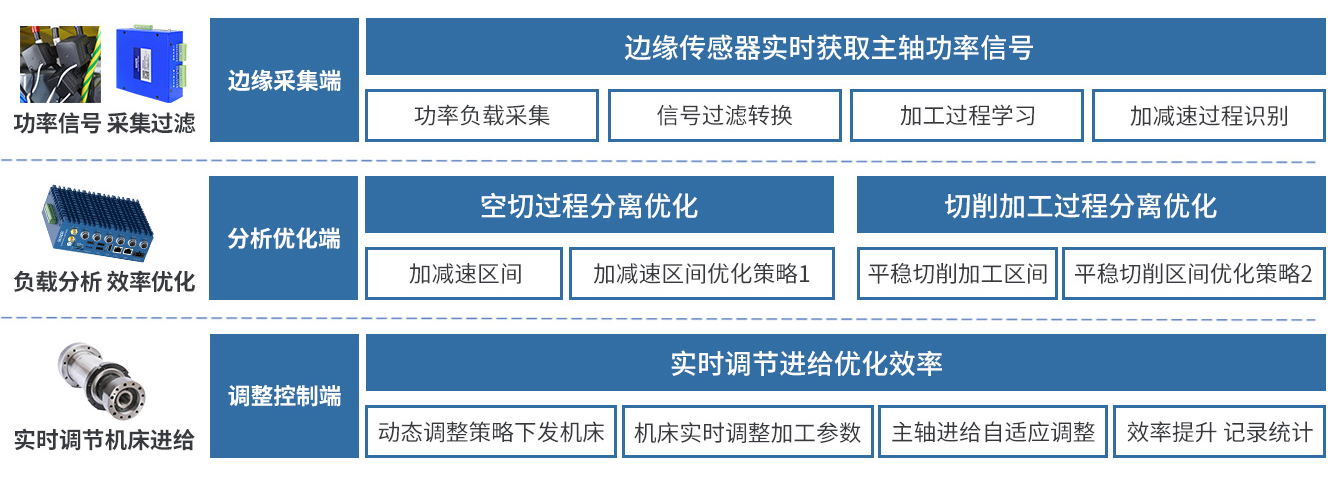
(效率优化原理及功能实现图)
三、实战检验:提效21.1%,细分环节全面提速
在立式加工中心加工刹车鼓法兰的实际场景中,西格数据AMS自适应加工系统交出了一份亮眼的成绩单:
原单件加工节拍:85秒
优化后单件加工节拍:67秒
综合加工效率提升:21.1%(缩短18秒)
细分环节表现同样强悍:粗加工提升 30%、半精加工提升 20%、精加工提升 10%。更重要的是,这一数据并未牺牲质量,产品尺寸精度与表面光洁度双双达标。
四、超越数据:为客户带来的全景价值
西格数据AMS自适应加工系统的价值,远不止于18秒的节拍缩短,它为企业构建了可持续进化的核心竞争力:
4.1 释放隐形产能:21.1%的效率提升,意味着在不增加设备的前提下,直接释放超过五分之一的产能。同样的设备、同样的人员,每天多产出近百件刹车鼓法兰。
4.2 全天候质量护航:智能平滑的进给调节,有效抑制断续切削引发的震颤。告别振刀纹,提升良品率、降低返修成本。
4.3 数字化智慧沉淀:将老师傅“凭感觉”的调速经验,转化为可量化、可学习、可复用的最优参数模型。新工艺、新工件、新员工的导入周期被大幅缩短。
4.4 构筑数字基石:持续积累的负载-进给数据流,为更深度的工艺优化、预测性维护乃至数字孪生构建了宝贵的核心数据资产。
五、快速部署,零风险验证:先试用,有效再付款
西格数据 AMS自适应加工系统助力制造业快速提效,部署简单无负担:
3天即可完成部署与培训,1小时就能上手操作;
无需停机改造、不改动原有程序;
兼容发那科、西门子、津上等98%以上数控系统;
基于一套硬件,还可按需无缝扩展TMS刀具监控、TCS主轴碰撞保护、CMS热补偿管理、DBS主轴动平衡监测和PHM健康管理六合一系统解决方案,助力企业打造数字化产线。
西格数据的AMS自适应加工系统,已在航空航天、精密模具、汽车零部件等多行业实战验证,可直接落地使用,真正把复杂交给技术、把简单留给车间。
我们更推出零风险验证模式,彻底打消您的顾虑:先试用、有效再付款,工程师带设备上门真机实测三天,用真实数据说话;机床提效后再买单,无效果分文不取,帮您无忧打破保守参数限制、释放机床潜能,欢迎来电咨询!
如您对西格数据的产品感兴趣,可以拨打电话:189 6235 3927(微信同号),也可以留下您的需求、电话和公司名称,我们会第一时间与您联系。

Swiss-type CNC lathe threading efficiency improved by 21.3%!
See how SIGER Data's adaptive machining system optimizes multi-axis relay cycle time, helping to reduce costs and increase efficiency!
Company News Date:2026/05/11

In an automotive parts machining workshop, a high-rigidity vertical machining center is tasked with the mass production of brake drum flanges. When dealing with such disc-shaped components—which demand exceptional machining stability and strict cycle-time targets—operators have long been caught in a "dilemma":
◆ Speeding up? The complex curved surfaces and frequent interrupted cuts mean that even the slightest misstep can trigger chatter, leaving unsightly vibration marks on the workpiece surface or even causing dimensional errors.
◆ Slowing down? Conservative feed parameters keep the processing time per unit high, leading to mounting pressure regarding production capacity.
Under traditional methods, process programming relied entirely on manual experience, lacking real-time monitoring or self-learning models. Parameters fine-tuned by veteran operators based on "feel" often proved ineffective when switching batches or cutting tools.
Today, the deep integration of the SIGER Data Adaptive Machining System (AMS) has completely dismantled the barrier between efficiency and quality, effectively equipping the machine tool with an "autonomous driving brain".
1. Addressing Key Pain Points: The "Triple Shackles" of Traditional Machining
When machining disc-shaped components such as brake drum flanges, the limitations of traditional fixed-feed strategies become glaringly apparent:
❌ Manual programming with no real-time monitoring: Programming cannot anticipate uneven machining allowances or hard spots in the material; consequently, feed rates must be set based on the most conservative parameters, resulting in significant periods of inefficiency where the machine's full potential remains untapped.
❌ Reliance on manual experience leads to inconsistent quality: Machining quality fluctuates with changes in tooling, production batches, or operators. The "feel" possessed by veteran machinists is neither quantifiable nor replicable.
❌ Lack of a learning model in the machining process: Each machining operation is treated as a "one-off" event; experience cannot be accumulated, leading to long process optimization cycles and slow results.
2. Intelligent Breakthrough: SIGER Adaptive Machining System Empowers Machine Tools with "Dynamic Thinking" Capabilities
The SIGER Adaptive Machining System (AMS) establishes a complete closed-loop process—"real-time sensing → AI decision-making → smooth execution"—moving beyond crude, blanket acceleration or deceleration strategies:
✅ Intelligent Feed Optimization for Precision Efficiency
High-precision spindle power sensors monitor loads in real-time. AI automatically identifies intervals for acceleration (increasing feed rates), deceleration (preventing overload and chatter), and air cutting (maintaining high speeds), ensuring the equipment consistently operates at peak efficiency.
✅ Closed-Loop Stability Control: Eliminating Chatter Marks
Real-time feedback controls load fluctuations; by suppressing overshoot and filtering noise, the system achieves continuous, smooth feed adjustments. This ensures fluid cutting action, delivering both high efficiency and superior surface finish.
✅ Continuous Self-Learning: Building Core Assets
Every cutting operation serves as a learning opportunity, gradually building a library of reusable, optimal parameter strategies. This significantly shortens the lead time for introducing new workpieces, reduces reliance on veteran machinists, and enables standardized production.
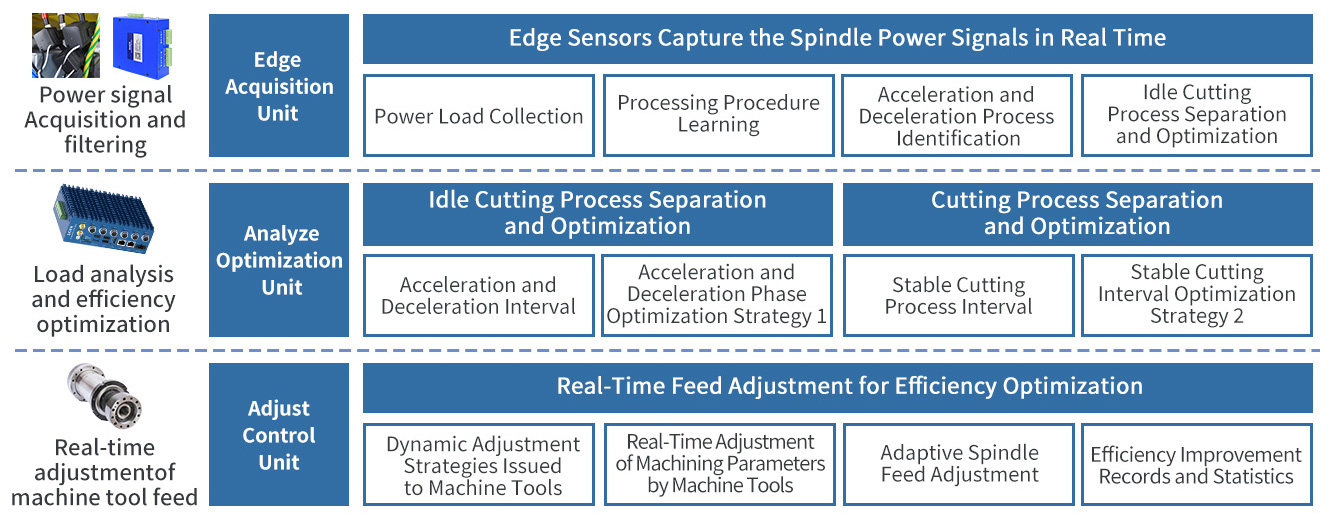
(Optimization principle and implementation diagram)
3. Real-world Testing: 21.1% Efficiency Gain with Accelerated Performance Across All Stages
In a real-world application involving the machining of brake drum flanges on a vertical machining center, the SIGER Data Adaptive Machining System delivered impressive results:
Original Single-Piece Machining Cycle Time: 85 seconds
Optimized Single-Piece Machining Cycle Time: 67 seconds
Overall Machining Efficiency Improvement: 21.1% (Reduced by 18 seconds)
Performance gains were equally robust across specific stages: 30% improvement in rough machining, 20% in semi-finishing, and 10% in finishing. Crucially, these gains were achieved without compromising quality; the product met all standards for dimensional accuracy and surface finish.
4. Beyond Data: Holistic Value for Customers
The value of the SIGER Data Adaptive Machining System (AMS) extends far beyond merely shaving 18 seconds off the cycle time; it builds a core competency of sustainable evolution for the enterprise:
4.1 Unleashing Capacity: A 21.1% efficiency gain translates to directly unlocking over one-fifth more production capacity without adding new equipment. Using the same machinery and workforce, the system yields nearly a hundred additional brake drum flanges daily.
4.2 Quality Assurance: Intelligent, smooth feed rate adjustments effectively suppress chatter caused by interrupted cutting. This eliminates chatter marks, boosts the yield rate, and reduces rework costs.
4.3 Intelligent Accumulation: It transforms the "gut-feeling" speed adjustment experience of veteran machinists into an optimal parameter model that is quantifiable, learnable, and reusable. This drastically shortens the lead times for introducing new processes, workpieces, and personnel.
4.4 Digital Foundation: The continuously accumulated load-versus-feed data streams create valuable core data assets that pave the way for deeper process optimization, predictive maintenance, and even the development of digital twins.
5. Rapid Deployment, Zero-Risk Validation: Try it first, pay only if effective
SIGER Adaptive Machining System (AMS) helps manufacturing industries quickly improve efficiency with simple and burden-free deployment:
Deployment and training can be completed in 3 days, and operation can be mastered in 1 hour.
No downtime or modification required, no changes to existing programs.
Compatible with over 98% of CNC systems, including FANUC, Siemens, and Tsugami.
Based on a single hardware system, it can also be seamlessly expanded on demand to provide a six-in-one solution encompassing Tool Monitoring System (TMS), Collision Protection System (TCS), Thermal Compensation Management System (CMS), Chip Detection System (CID), and Health Management System (PHM), helping enterprises build digital production lines.
SIGER's Adaptive Machining System (AMS) has been proven in real-world applications across multiple industries, including aerospace, precision mold making, and automotive parts. It's ready for immediate deployment, truly empowering the technology team and simplifying the workshop.
We also offer a zero-risk verification model to completely eliminate your concerns: try it first, pay only if effective. Our engineers will bring the equipment to your location for three days of on-site testing, letting real data speak for itself. Pay only after your machine tool efficiency improves; if there are no results, you don't pay a cent. This helps you break free from conservative parameter limitations and unleash your machine tool's potential. Welcome to contact us for inquiries!
If you are interested in SIGER products, you can contact us by phone or email, or submit your requirements by leaving a message, and we will arrange personnel to contact you as soon as possible.
--------------------------------------------------------------------------------------------------------------------------------------------------------
Official Contact Info:
Email: marketing@siger-data.com
WhatsApp: +86 189 6235 3927
WeChat: 189 6235 3927