三天提效15%!揭秘西格数据AMS如何让传统机加工企业“智”取效率
公司动态 日期:2026/03/23

在传统机加工车间,效率提升往往被视为一场“持久战”:工程师需要反复调试参数、积累经验、优化工艺,周期长、见效慢。
但今天,随着西格数据AMS自适应加工系统的引入,这一切正在被彻底改写--仅需三天,就能让一家传统机加工企业实现15%以上的综合效率跃升。
第一天:安装调试,让机床“学会感知”
上午,西格数据工程师抵达客户现场,为一台正在承担精加工任务的小型立式加工中心安装AMS自适应加工系统。整个过程无需停机改造、不改变原有CNC程序,仅需加装高精度功率传感器,并与机床控制系统完成数据对接。
当天下午,工程师在系统中完成初始配置,系统进入“感知学习阶段”。AMS通过实时采集主轴负载信号,建立起该机床在当前工艺下的“切削负荷基线”。无论是余量不均、材料硬点,还是刀具轻微磨损,系统都能在毫秒级内精准感知。
第一天,机床装上“神经末梢”,具备实时感知切削状态的能力,完成系统调试和基线建立。
第二天:AI决策介入,实现“动态优化”
第二天,系统进入“智能干预阶段”。AMS系统基于第一天的切削负荷基线,自动生成优化的目标负载阈值。工程师对生成的阈值进行确认后,系统内置的AI决策引擎开始实时对比实际负载与目标值,并自主调节进给倍率:
✅ 当负载偏低时,系统自动“踩油门”,提升进给速度,挖掘效率潜力;
✅ 当负载接近上限时,系统智能“踩刹车”,降速避振,保障加工安全;
整个过程无需人工干预,进给调节平滑连续,确保切削过程稳定高效。AI模型在每一次切削中持续学习,优化决策策略。
第二天,机床具备“自主决策”能力,通过AI智能学习实现切削过程的实时优化。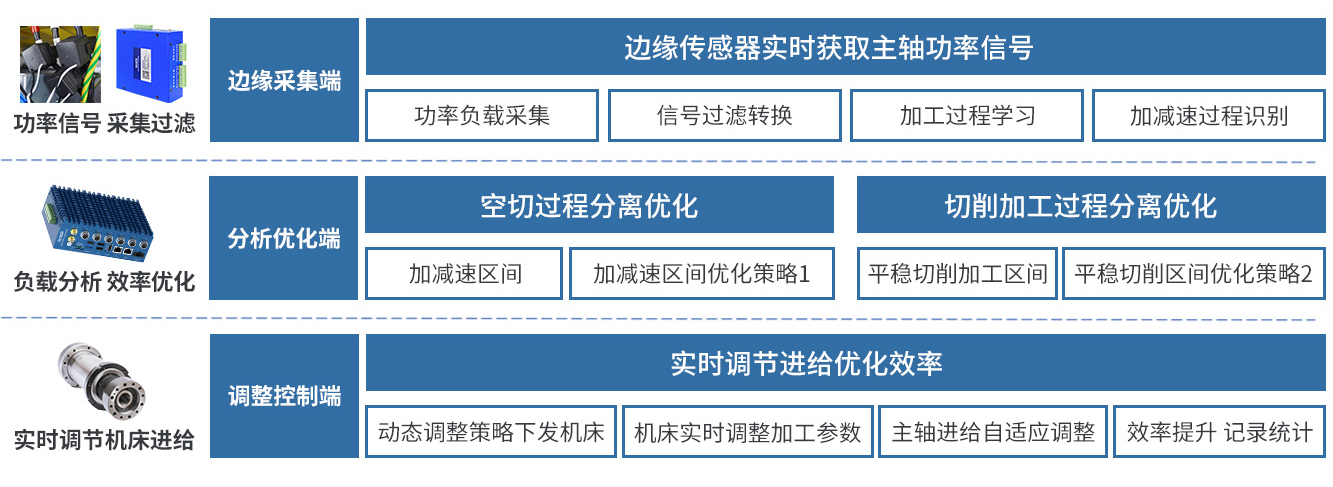
(效率优化原理及功能实现图)
第三天:验证效果,效率提升立竿见影
第三天,AMS效率优化系统已完成对当前工序的完整学习与优化。对这台承担精加工任务的小型立式加工中心,我们对比了优化前后的加工数据:
原单件加工节拍:922秒
优化后单件加工节拍:783秒
整体效率提升:15.08%
更重要的是,这一提升并未以牺牲质量为代价。AMS系统通过平滑控制保证了加工过程的稳定性,确保了优异的表面光洁度,同时降低了刀具异常磨损风险。
第三天: 在不增加设备、不改变工艺的前提下,实现效率跃升15%以上,远超预期。
四、不止于三天:西格数据AMS自适应加工系统的全景价值
虽然SIGER自适应加工系统能在三天内带来立竿见影的提效成果,但其价值远不止于此:
◼ 经验固化:每一次加工都转化为可复用的最优参数模型,减少对老师傅经验的依赖;
◼ 持续进化:AI模型在同类工件、材料中不断学习,越用越“聪明”;
◼ 平台扩展:基于同一硬件平台,可无缝集成刀具监控、碰撞保护、热补偿管理等系统,构建协同智能产线。
三天,能让一家传统机加工企业实现15%以上的效率提升,靠的不是“换设备”或“调参数”,而是让机床学会“思考”——这正是西格数据AMS自适应加工系统的核心价值。它不只是效率工具,更是推动制造从“经验驱动”走向“数据驱动”的关键引擎。
五、快速了解SIGER AMS自适应加工系统
西格数据AMS自适应加工系统(Adaptive Machining System)基于实时监控技术与智能调整算法,实现机床主轴功率实时调整,结合切削过程工艺学习,自动将主轴进给倍率调整至最佳参数。同时AMS效率优化系统针对特定的刀具和零件材料,结合对应刀具工艺负载设定上限,在加工过程中出现负载较大的工况下,则会自动减少进给速度,在保障加工质量与设备安全的前提下,降低加工节拍,综合效率提升15%-30%。
SIGER AMS自适应加工系统适配范围:
适用机床类型:加工中心、龙门、车床、车铣复合等多种机床切削场景;
适用加工方式:车削加工|铣削加工|钻孔|攻丝|齿面加工|曲面等多种粗加工、精加工场景;
如您对西格数据的产品感兴趣,可以拨打电话:189 6235 3927(微信同号),也可以留下您的需求、电话和公司名称,我们会第一时间与您联系。

15% Efficiency Improvement in Three Days
Unveiling How SIGER Data's Efficiency Optimization System Enables Traditional Machining Companies to "Smartly" Achieve Efficiency
Company News Date:2026/03/16

In traditional machining workshops, efficiency improvements are often seen as a protracted battle: engineers need to repeatedly debug parameters, accumulate experience, and optimize processes, resulting in long cycles and slow returns.
But today, with the introduction of the SIGER Data Adaptive Machining System (AMS), all of this is being completely rewritten—in just three days, a traditional machining company can achieve a comprehensive efficiency leap of over 15%.
Day 1: Installation and Commissioning, Enabling the Machine Tool to "Learn to Perceive"
In the morning, SIGER Data engineers arrived at the customer's site to install the AMS adaptive machining system on a small vertical machining center currently performing finishing tasks. The entire process required no downtime modifications or changes to the existing CNC program.only the installation of a high-precision power sensor and data integration with the machine tool's control system were necessary.
That afternoon, engineers completed the initial configuration of the system, and the system entered the "perception and learning phase". AMS establishes a "cutting load baseline" for the machine tool under the current process by real-time acquisition of spindle load signals. Whether it's uneven allowance, material hard spots, or slight tool wear, the system can accurately perceive it within milliseconds.
On the first day, the machine tool was equipped with "nerve endings",enabling it to perceive the cutting status in real time and complete system debugging and baseline establishment.
Day 2: AI Decision-Making Intervention for "Dynamic Optimization"
On the second day, the system enters the "intelligent intervention phase." Based on the cutting load baseline from the first day, the AMS system automatically generates an optimized target load threshold. After engineers confirm the generated threshold, the system's built-in AI decision engine begins to compare the actual load with the target value in real time and autonomously adjusts the feed rate:
✅ When the load is too low, the system automatically "accelerates," increasing the feed rate to maximize efficiency.
✅ When the load approaches its upper limit, the system intelligently "brakes," reducing speed and mitigating vibration to ensure machining safety.
The entire process requires no manual intervention, feed adjustment is smooth and continuous, ensuring a stable and efficient cutting process. The AI model continuously learns and optimizes its decision-making strategy with each cut.
On the second day, the machine tool possesses "autonomous decision-making" capabilities, achieving real-time optimization of the cutting process through AI intelligent learning.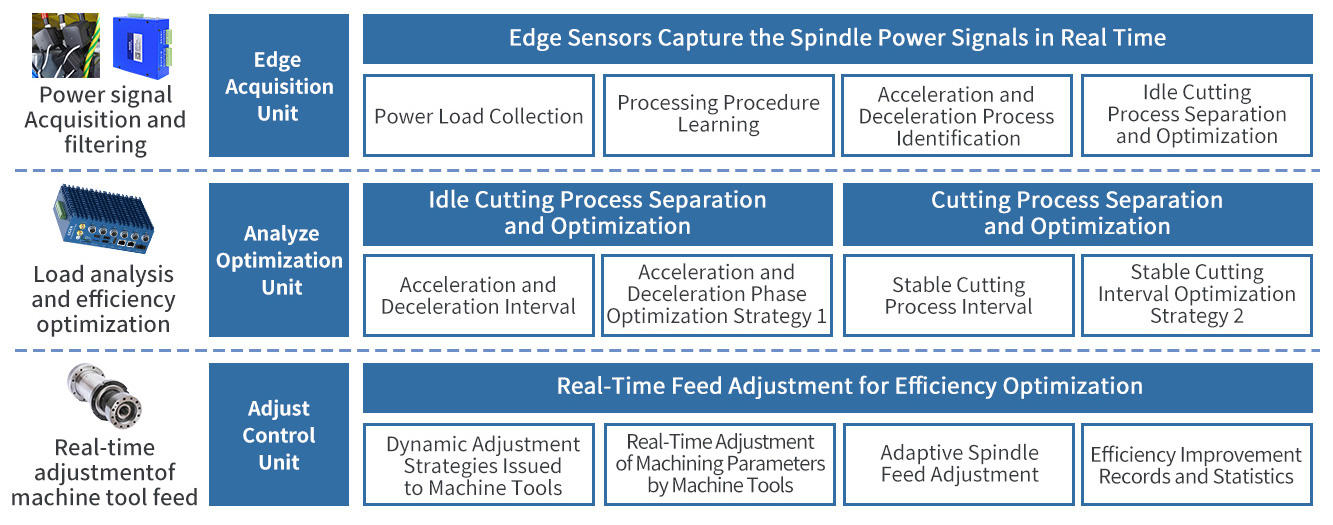
(Efficiency Optimization Principle and Function Implementation Diagram)
Day 3: Verifying Results, Immediate Efficiency Improvement
On the third day, the efficiency optimization system had completed its full learning and optimization of the current process. For this small vertical machining center undertaking the finishing task, we compared the machining data before and after optimization:
Original single-piece machining cycle time: 922 seconds
Optimized single-piece machining cycle time: 783 seconds
Overall efficiency improvement: 15.08%
More importantly, this improvement did not come at the expense of quality. The SIGER Data Efficiency Optimization System ensured the stability of the machining process through smooth control, guaranteeing excellent surface finish while reducing the risk of abnormal tool wear.
Day 3: Achieving an efficiency jump of over 15% without adding equipment or changing the process, far exceeding expectations.
4. More Than Three Days: The Panoramic Value of SIGER Data's Adaptive Machining System
While the SIGER Adaptive Machining System delivers immediate efficiency gains within three days, its value extends far beyond that:
◼ Experience Consolidation: Each machining operation is transformed into a reusable optimal parameter model, reducing reliance on experienced operators.
◼ Continuous Evolution: The AI model learns continuously from similar workpieces and materials, becoming increasingly "intelligent" with use.
◼ Platform Expansion: Based on the same hardware platform, it can seamlessly integrate systems such as tool monitoring, collision protection, and thermal compensation management, building a collaborative intelligent production line.
In just three days, a traditional machining company can achieve an efficiency improvement of over 15%, not by "changing equipment" or "adjusting parameters," but by enabling machine tools to "think"—this is the core value of the SIGER Data Adaptive Machining System. It's not just an efficiency tool, but a key engine driving manufacturing from "experience-driven" to "data-driven".
5. Extensive Validation: Empowering the Future of High-End Manufacturing
SIGER Data's Adaptive Machining System (AMS) utilizes real-time monitoring technology and intelligent adjustment algorithms to achieve real-time adjustment of machine tool spindle power. Combined with cutting process learning, it automatically adjusts the spindle feed rate to optimal parameters. Simultaneously, the AMS efficiency optimization system sets upper limits for specific tools and part materials, based on the corresponding tool process load. Under conditions of high load during machining, it automatically reduces the feed rate, lowering the machining cycle time while ensuring machining quality and equipment safety, resulting in an overall efficiency improvement of 15%-30%.
SIGER Data Adaptive Machining System Compatibility:
Applicable Machine Tool Types: Machining centers, gantry milling machines, lathes, mill-turn centers, and other cutting scenarios.
Applicable Machining Methods: Turning, milling, drilling, tapping, tooth surface machining, curved surface machining, and other roughing and finishing scenarios.
If you are interested in SIGER products, you can contact us by phone or email, or submit your requirements by leaving a message, and we will arrange personnel to contact you as soon as possible.
--------------------------------------------------------------------------------------------------------------------------------------------------------
Official Contact Info:
Email: marketing@siger-data.com
WhatsApp: +86 189 6235 3927
WeChat: 189 6235 3927